
Every delivery starts with a data entry moment.
A customer types an address into a checkout form. A patient enters contact information during intake. A sales team imports a list into a CRM. A billing system pulls mailing data from an account record. If that address is incomplete, outdated, misspelled, or not recognized for delivery, the problem travels with it.
By the time the error shows up, it is usually more expensive to fix. The order may already be delayed. The mailpiece may already be printed. The customer may already be contacting support. The campaign report may already include records that never had a real chance of reaching anyone.
Address verification software helps teams catch those errors earlier. Instead of cleaning up address problems after they affect fulfillment, mail, billing, or customer communications, teams can validate and standardize address data before it enters the workflow.
What is address verification software?
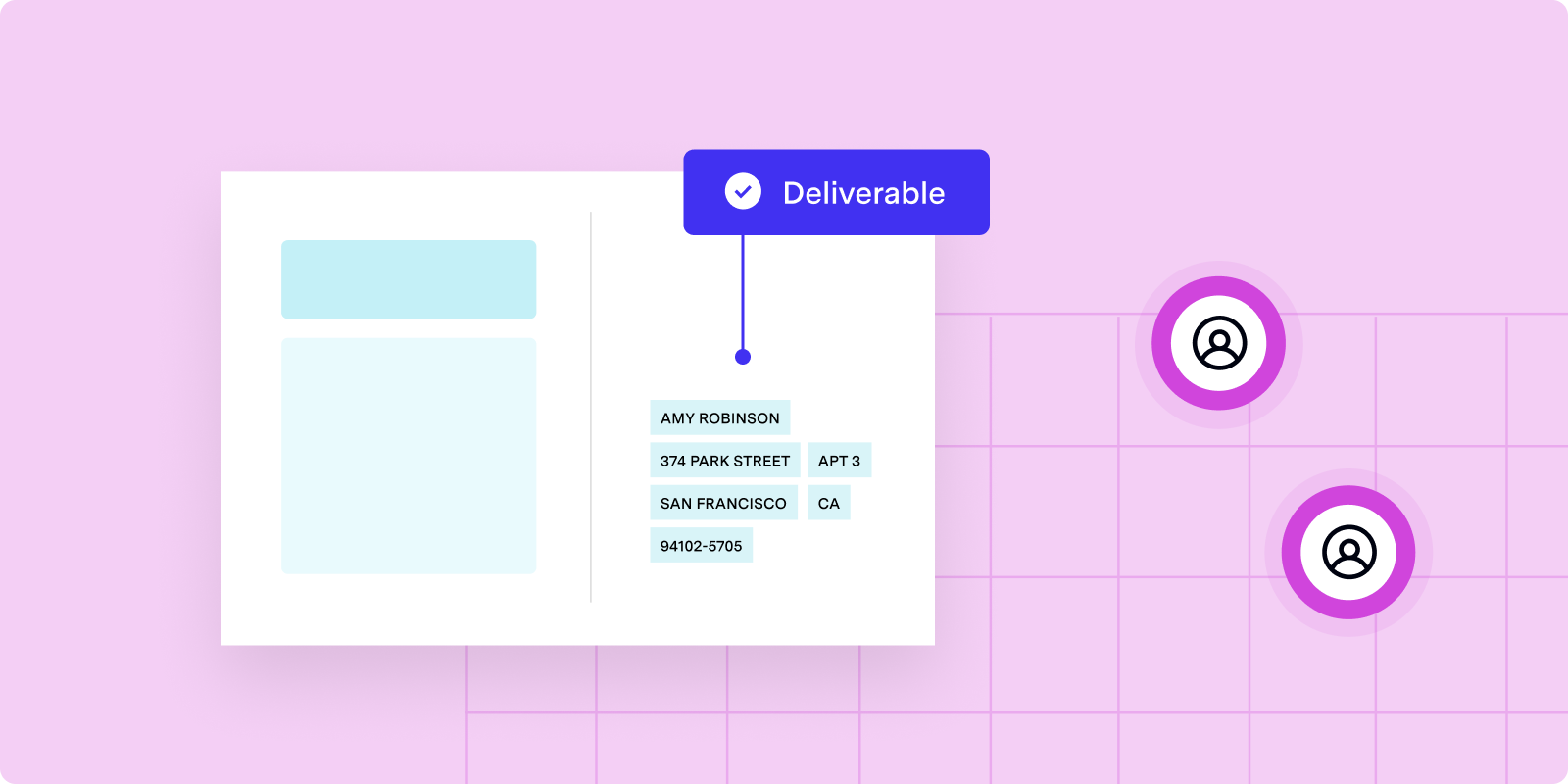
Address verification software checks address data to determine whether it is complete, standardized, and recognized for delivery.
It can help correct common issues such as:
- Misspelled street or city names
- Incorrect ZIP Codes
- Missing apartment or suite numbers
- Incomplete address fields
- Nonstandard formatting
- Undeliverable or questionable records
- Duplicate or inconsistent address entries
The goal is simple: help teams collect usable address data before it becomes an operational problem.
For ecommerce, address verification can support smoother checkout and fewer avoidable fulfillment issues. For direct mail, it can reduce waste before campaigns go into production. For billing, healthcare, financial services, insurance, and other customer communication workflows, it can help ensure important mail is sent to cleaner, more reliable records.
Lob’s address verification helps teams validate, standardize, and enrich address data before it moves into direct mail, customer communications, or other address-dependent workflows.
Why address errors are expensive to fix later
Address errors rarely stay isolated.
One missing unit number can create a delayed shipment, a returned mailpiece, a replacement order, a support ticket, and a frustrated customer. At scale, those small errors turn into measurable operational waste.
Common downstream effects include:
- Returned mail
- Failed deliveries
- Duplicate sends
- Delayed orders
- Higher support volume
- Manual data cleanup
- Inaccurate campaign reporting
- Poor customer experience
- Missed or delayed customer communications
The earlier you catch the issue, the easier it is to resolve. A customer can correct an address in seconds while filling out a form. Fixing that same error after a shipment fails or a mailpiece is returned takes more time, more people, and more cost.
That is why address verification works best at the point of entry.
Where address verification should happen
Address verification can support multiple workflows, but the strongest starting point is wherever address data first enters your business.
Checkout flows
Ecommerce and subscription businesses rely on accurate shipping and billing addresses. Address suggestions and real-time verification can help customers enter complete address details before an order is placed.
This reduces the chance that a typo, missing apartment number, or invalid ZIP Code turns into a fulfillment issue later.
Lead forms and account creation
Forms often become the first source of truth for customer data. If address information enters the system incorrectly, that same record may later flow into marketing, billing, sales, shipping, and support tools.
Verifying addresses during account creation or lead capture keeps cleaner data moving through the rest of the business.
CRM and database imports
Customer databases change over time. People move, records get duplicated, and teams often import address lists from multiple systems.
Running address verification before a major CRM import, campaign launch, or operational send can help standardize records and flag issues before they affect customers.
Direct mail campaigns
Direct mail teams should verify addresses before production. Once a campaign is printed and mailed, an undeliverable record has already created cost.
Address verification helps teams send to cleaner lists, reduce avoidable returned mail, and improve the reliability of campaign measurement.
Lob’s guide to address quality checks for direct mail operations explains how address checks can support stronger mail performance before production.
Operational communications
Statements, notices, renewals, policy updates, appointment reminders, and other operational mail depend on accurate recipient data.
For these workflows, address verification can help reduce the risk of important communications being delayed, returned, or sent to an incomplete address.
Address verification vs. address validation
Address validation and address verification are often used interchangeably, but they can refer to different levels of checking.
Address validation usually checks whether an address follows expected formatting rules. Address verification goes further by checking whether the address is recognized and can receive mail.
Both are useful, but formatting alone does not prove deliverability.
For example, an address may look complete and follow a standard format, but still have a missing apartment number or an invalid delivery point. For mail, fulfillment, billing, and regulated communications, teams need more than clean formatting. They need confidence that the address can actually be used.
Lob’s guide to address validation and address verification explains how these processes work together.
What address verification software can help teams do
Address verification software gives teams a more reliable way to manage address data across systems and workflows.
It can help teams:
- Catch errors in real time before customers submit forms or orders
- Standardize address formats across systems, teams, and regions
- Improve deliverability by identifying incomplete or questionable records
- Reduce manual cleanup by automating address checks
- Support better customer experiences by reducing avoidable delivery issues
- Improve direct mail performance by sending to cleaner address lists
- Enrich address records with metadata that supports routing, segmentation, and reporting
Address verification does not guarantee that every delivery will succeed. Carrier operations, recipient moves, local delivery conditions, and other factors can still affect outcomes. But it gives teams a better foundation by improving the quality of the address data they use.
What to look for in address verification software
The right address verification software depends on how your team collects and uses address data.
Here are the capabilities to evaluate.
Real-time verification
Real-time verification helps catch errors while someone is still entering the address.
This matters for checkout pages, forms, onboarding flows, and customer portals because the user can correct the issue immediately instead of creating a bad record that has to be fixed later.
Address suggestions
Address suggestions help users complete address fields faster by showing likely matches as they type.
This can reduce entry errors and make forms easier to complete, especially on mobile devices where typing long address fields is more frustrating.
Standardization
Standardization puts addresses into a consistent format.
That makes records easier to store, compare, deduplicate, and use across systems. It also supports cleaner direct mail production and more consistent reporting.
Deliverability checks
Deliverability checks help determine whether an address is recognized as a location that can receive mail.
This is one of the most important capabilities for teams sending direct mail, customer notices, statements, packages, or other physical communications.
Address enrichment
Address enrichment adds useful metadata to an address record. Depending on the address and market, that may include details such as residential or commercial classification, vacancy information, building type, delivery point data, or geocode data.
That information can support segmentation, routing, reporting, and operational planning.
Global coverage
If your business collects addresses outside the U.S., global coverage matters.
Address formats vary across countries and territories. A verification tool should support the regions where your customers, recipients, or account holders are located.
API access
An address verification API lets teams add address checks directly into the systems they already use.
That may include ecommerce platforms, CRMs, customer portals, billing systems, internal tools, or direct mail workflows.
What you get with Lob’s Address Verification API
Lob’s Address Verification API helps teams verify, standardize, correct, and enrich address data before it moves into customer-facing or operational workflows.
With Lob, teams can support address verification across direct mail, ecommerce, CRM hygiene, billing, customer communications, and other address-dependent processes.
U.S. and international address verification
Lob supports address verification across more than 240 global territories, helping teams work with both domestic and international address data.
U.S. CASS-certified address verification
For U.S. addresses, Lob’s Address Verification API is CASS certified. CASS certification is a USPS program that evaluates address-matching software for accuracy across postal data elements.
That helps teams standardize U.S. addresses and access postal metadata that can support stronger address quality and mail preparation.
Real-time correction and standardization
Lob helps correct misspellings, standardize formatting, and fill in missing address components when possible.
That keeps address records cleaner before they enter CRMs, production systems, direct mail workflows, or customer communication programs.
Address enrichment
Lob can return enriched address metadata that helps teams better understand and act on address data.
This can support deliverability checks, segmentation, routing, campaign planning, and reporting.
API-based workflows
Lob’s Address Verification API can be built into the systems where address data is collected, stored, or used.
Teams can verify addresses one at a time, validate addresses as they are entered, or clean larger address lists before a campaign or operational send.
Direct mail workflow support
Because Lob also supports automated direct mail, address verification can fit directly into the mailing workflow.
Teams can verify and standardize addresses before sending campaigns, statements, notices, invoices, or other customer communications. Lob’s guide to high-volume direct mail automation explains how automated workflows can help reduce manual errors as mail programs scale.
How address verification supports regulated workflows
For regulated industries, address accuracy can affect more than delivery performance.
Healthcare, financial services, insurance, and other regulated teams often send sensitive, time-sensitive, or compliance-related communications. When address records are incomplete or outdated, important mail can be delayed, returned, or sent to the wrong place.
Address verification helps teams catch address issues before mail enters production. It can also support cleaner documentation by showing that address quality checks are part of the workflow.
For regulated direct mail programs, address verification is one piece of a broader compliance process. Lob’s article on direct mail compliance explains how address verification, vendor controls, production visibility, and documentation work together.
How to get started with address verification
Start by identifying where address data enters your business and where address errors create the most downstream work.
Common starting points include:
- Customer-facing forms:
Use address suggestions and real-time verification to reduce errors at entry. - Checkout flows:
Validate shipping or mailing addresses before orders are submitted. - CRM imports:
Standardize and verify records before they become active customer data. - Direct mail campaigns:
Verify address lists before production to reduce waste and improve deliverability. - Operational mail workflows:
Check addresses before sending statements, notices, invoices, renewals, or other important communications.
The best place to begin is usually the workflow where errors are easiest to prevent and most expensive to fix later.
Improve address data before delivery depends on it
Address verification software helps teams collect cleaner address data, reduce avoidable delivery issues, and keep customer records more reliable across systems.
With Lob Address Verification, teams can validate, standardize, correct, and enrich address data through API-based workflows that support direct mail, ecommerce, CRM hygiene, billing, and operational communications.
See how Lob helps teams improve address quality before it creates delivery problems by booking a demo.
Frequently asked questions about address verification software
FAQs

What does address verification software do?
Address verification software checks address data for accuracy, formatting, completeness, and deliverability. It helps teams catch issues like typos, missing apartment numbers, invalid ZIP Codes, and undeliverable records before they create delivery problems.
Why does address verification matter?
Address verification helps reduce returned mail, failed deliveries, duplicate sends, and unnecessary operational work. It also keeps customer records cleaner across CRMs, ecommerce platforms, billing systems, and direct mail workflows.
When should teams verify addresses?
Teams should verify addresses as early as possible, ideally when the address is entered into a form, checkout flow, CRM, or customer database. Address checks are also useful before direct mail campaigns, billing cycles, and other operational sends.
Answered by:

Sam Melero