Direct mail gets messy when a campaign stops being occasional.
One cart reminder is easy to manage. So is one regional postcard drop. The trouble starts when several customer events, audience rules, and creative versions are running at the same time. Someone has to pull the list, confirm the addresses, choose the right template, send the files, and figure out what happened afterward.
Direct mail automation turns those handoffs into a workflow. A customer action or data change starts the process, the appropriate content is selected, and the mailpiece moves into production without requiring a new spreadsheet for every send.
The result is not simply faster direct mail. It is mail that responds to what customers are doing instead of waiting for the next scheduled campaign.
What is direct mail automation?
Direct mail automation uses software, integrations, or APIs to create and send physical mail based on predefined rules.
A trigger might be a purchase, an abandoned application, an upcoming renewal, a CRM stage change, or a period of inactivity. Once the customer meets the campaign conditions, the workflow selects the appropriate template, adds customer data, verifies the mailing address, and submits the piece for production.
This replaces manual tasks such as:
- Exporting mailing lists
- Merging spreadsheets
- Matching customers with creative versions
- Formatting addresses
- Sending files to a print vendor
- Checking campaign status manually
- Rebuilding recurring campaigns
The workflow can be connected through an API, a native integration, a marketing automation platform, or a no-code tool. The best setup depends on the systems you use, the complexity of your campaign rules, and the technical resources available.
How does direct mail automation work?
Most automated direct mail workflows follow the same basic process:
- A customer action or data change occurs.
- The system checks whether the customer meets the campaign conditions.
- Suppression and frequency rules remove anyone who should not receive the piece.
- Customer data is added to an approved template.
- The mailing address is verified.
- The mailpiece enters production.
- Production and postal activity are recorded.
- Response and conversion data return to the team’s reporting systems.
Each step should have a clear owner and a defined response when something goes wrong.
For example, what happens if the address cannot be verified? Should the workflow stop, send the record for manual review, or fall back to another channel? What happens if the customer converts after the trigger fires but before the piece enters production?
Those details separate a reliable automation from one that simply sends mail faster.
1. Trigger mail after high-intent customer behavior
Some customer actions signal stronger interest than others.
A single homepage visit probably does not justify a mailpiece. Repeated product views, an abandoned high-value cart, or an incomplete application may indicate that the customer is closer to making a decision.
Possible behavioral triggers include:
- Abandoning a cart above a defined value
- Viewing the same product several times
- Visiting a pricing page repeatedly
- Starting but not completing an application
- Downloading a high-intent resource
- Completing an email sequence without converting
- Requesting information but not taking the next step
Define the trigger precisely. “Visited the website” is too broad. A better rule might be:
Send a postcard to customers who viewed the same product at least three times within seven days, have a verified mailing address, and have not purchased the product.
The workflow should also include a waiting period when appropriate. Giving the customer 24 or 48 hours to complete the purchase digitally may prevent unnecessary sends.
Before the piece enters production, check whether the customer has already converted. A final eligibility check prevents someone from receiving a reminder for an action they already completed.
2. Automate mail around lifecycle dates and deadlines
Lifecycle campaigns are based on where someone is in their relationship with the business.
These workflows are usually more predictable than behavioral campaigns because the relevant date or status already exists in your CRM or account system.
Potential triggers include:
- A subscription approaching renewal
- A trial nearing its end
- An account anniversary
- A loyalty tier change
- A customer reaching a replenishment window
- A payment deadline
- A service appointment coming due
- A period of customer inactivity
Timing matters because physical mail requires production and postal transit. Do not trigger a renewal reminder on the day the subscription expires. Work backward from the date you want the piece to arrive.
A renewal workflow might look like this:
- The renewal date is 30 days away.
- The customer has not already renewed.
- The mailing address is verified.
- The correct plan and renewal details populate the template.
- The piece is submitted early enough to arrive during the intended response window.
- The workflow stops if the customer renews before production.
Clear CRM-triggered direct mail rules help teams account for eligibility, timing, suppression, address quality, and attribution instead of treating the trigger as the entire workflow.
3. Use geographic triggers for local campaigns
Geographic automation is useful when the offer or service changes based on where someone lives.
A campaign might target recipients near a new store, branch, service area, or event. It could also adjust the message based on local inventory, regional availability, or the nearest location.
Geographic signals may include:
- ZIP code
- City or region
- Distance from a location
- Service availability
- New market entry
- Store or branch opening
- Local event registration
- A customer moving into a supported area
The location should change something meaningful about the campaign. Simply placing a city name in the headline is not enough if every recipient receives the same generic offer.
Geographic data can determine:
- The nearest location
- The featured service
- Available products
- Regional imagery
- Local contact information
- Event details
- Offer terms
- The landing page
- The call to action
Set boundaries carefully. A recipient may technically fall within a ZIP code while still being outside the practical service area. Distance, delivery coverage, local regulations, or inventory may require more specific rules.
Geographic workflows should also account for people who move. Verify mailing addresses before each send rather than assuming a location stored months ago is still correct.
4. Respond to CRM stage and service events
Not every useful trigger comes from marketing behavior.
Sales, customer service, and account teams record events that can support timely direct mail. These workflows can reinforce important conversations without requiring an employee to request each mailpiece manually.
Possible triggers include:
- A lead becoming qualified
- A proposal being sent
- A high-value opportunity stalling
- A customer completing onboarding
- A support issue being resolved
- An account being marked at risk
- A referral being completed
- A customer reaching a spending threshold
A sales workflow might trigger a personalized letter after a qualified prospect attends a demonstration but does not respond to digital follow-up.
A service workflow might send a thank-you note after an issue is resolved, but only when the case meets approved conditions. Sensitive complaints, unresolved problems, and customers who opted out of applicable communications should be excluded.
These automations require coordination between teams. Marketing may create the template, but sales or customer service should help define when the message is appropriate.
Document:
- The exact status change that fires the workflow
- Which records qualify
- Which records must be excluded
- How long the system waits before sending
- Whether a later status change cancels the piece
- Who reviews errors
- Where the activity appears in the CRM
Avoid vague triggers such as “contact updated.” A broad rule can fire when an unrelated field changes and create mail that makes no sense to the recipient.
5. Coordinate digital follow-up with postal activity
Automation does not have to end when the mailpiece enters production.
Production and postal events can update the CRM or marketing automation platform, giving your team more context for follow-up. Instead of sending an email on an arbitrary date, you can coordinate the next step around the mailpiece’s progress.
Depending on the available tracking signals, teams may use postal activity to:
- Schedule an email near the expected arrival window
- Alert a sales representative that mail is moving
- Add a recipient to a related advertising audience
- Delay another campaign to prevent overlapping messages
- Start the response measurement window
- Investigate pieces that do not progress as expected
Tracking signals require context. A production event does not mean the piece reached the recipient, and a postal scan should not automatically be treated as proof that someone saw the mail.
The purpose of direct mail visibility and tracking is to understand how pieces move, improve campaign coordination, and connect likely exposure with response data.
Use postal information alongside QR code scans, personalized URL visits, promotional code redemptions, calls, purchases, and CRM activity. No single signal tells the complete story.
Set automation rules before turning on the campaign
A trigger tells the workflow when to start. It does not tell the workflow everything it needs to know.
Before launching, define the rules that protect customers and prevent wasted sends.
Eligibility rules
Specify the conditions a customer must meet.
A reactivation campaign might require a previous purchase, a defined period of inactivity, and a minimum historical order value.
Suppression rules
Remove customers who should not receive the campaign.
This might include people who:
- Already converted
- Recently received the same piece
- Do not have a valid address
- Opted out of applicable communications
- Belong to an excluded region
- Have an unresolved service issue
- No longer meet the original criteria
Frequency limits
Decide how often someone can enter the workflow.
Without frequency limits, repeated website activity or CRM updates could generate several similar mailpieces for the same person.
Cancellation rules
Identify which actions should stop the piece before production.
A purchase, renewal, account closure, or sales response may make the original message irrelevant.
Failure handling
Decide what happens when:
- An address cannot be verified
- A required field is missing
- A template fails to render
- The integration returns an error
- The same event is recorded twice
- The customer data conflicts across systems
Automation should reduce manual work, but unusual records still need a clear path for review.
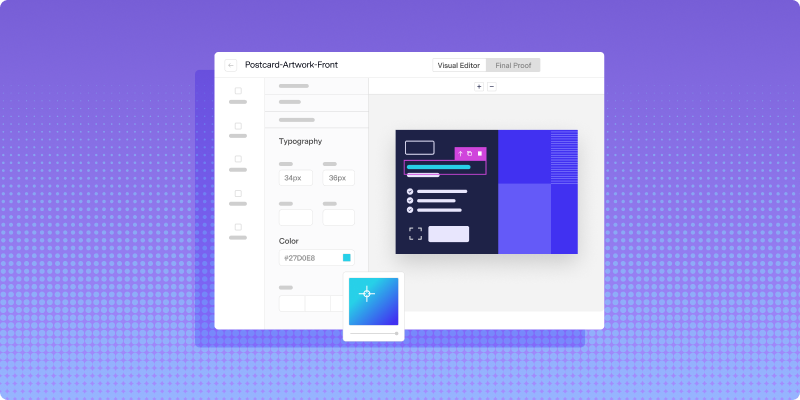
Personalize one template with conditional logic
Automated campaigns do not need a separate template for every audience.
Variable data and conditional logic allow one approved design to display different content based on customer information. A loyalty customer might see one offer, while a lapsed customer sees another. The image, headline, location, and call to action can also change.
Useful variable fields include:
- Customer name
- Product or service
- Account status
- Loyalty tier
- Location
- Offer
- Expiration date
- Representative
- QR code
- Landing page
The right variable data and conditional logic platform can support several campaign variations without requiring teams to manage each version in a separate file.
Test the template with real-world data before launch. Review records containing:
- Long and short names
- Apartment numbers
- Missing optional fields
- Several offer variations
- Different image dimensions
- Long URLs
- Regional disclosures
- The maximum expected copy length
Confirm that every possible combination reads naturally and fits the design.
Measure whether the automation is working
An automated campaign has two types of performance to evaluate.
First, determine whether the workflow operates correctly:
- Did the right customers enter?
- Were ineligible customers suppressed?
- Did addresses verify successfully?
- Did the correct template render?
- Did the piece enter production on time?
- Were duplicate sends prevented?
- Did tracking data return to the right system?
Then evaluate whether the campaign achieved its business goal:
- Responses
- Conversions
- Purchases
- Renewals
- Reactivations
- Appointments
- Pipeline movement
- Revenue
- Cost per conversion
Use a trackable response method on every campaign. QR codes, personalized URLs, promotional codes, campaign landing pages, and dedicated phone numbers can connect customer actions to a specific mailpiece or audience.
Testing should answer one clear question at a time. A controlled direct mail A/B test might compare two offers, formats, headlines, or calls to action while keeping the remaining campaign elements consistent.
Do not change the trigger, audience, design, offer, and timing simultaneously. You may see different results, but you will not know what caused them.
Start with one trigger that solves a real problem
The best first automation is not necessarily the most creative one. It is the workflow that removes a recurring manual task or addresses a customer moment your current channels are missing.
Look for a campaign with:
- A clearly defined trigger
- Reliable customer data
- A verified mailing address
- A reusable message
- A valuable next action
- Enough time for production and delivery
- A measurable result
Run the workflow with a controlled audience, watch for errors, and confirm that customers receive the correct message. Once the process is stable, expand the audience or introduce another trigger.
Lob connects customer data, conditional templates, address verification, print production, postal visibility, and campaign measurement in one platform. Book a demo to see how your team can build automated direct mail workflows without adding more manual coordination.
Frequently asked questions about direct mail automation
FAQs

What is the difference between automated and traditional direct mail?
Traditional direct mail is often sent as a batch to a fixed list on a scheduled date.
Automated direct mail is initiated by customer behavior, account data, lifecycle dates, or other predefined conditions. Each qualifying customer can enter the workflow at the appropriate moment.
Does direct mail automation require an API?
No. Businesses can automate direct mail through native integrations, marketing automation platforms, no-code tools, or APIs.
An API provides more flexibility for custom systems, complex rules, and developer-managed workflows. Native and no-code integrations may be easier for teams with standard campaign requirements.
What should trigger an automated direct mail campaign?
Use events that are meaningful, measurable, and valuable enough to justify a physical communication.
Examples include an abandoned high-value purchase, an upcoming renewal, an incomplete application, a qualified lead going quiet, or a customer crossing an inactivity threshold.
How do you prevent incorrect automated mail?
Use precise triggers, eligibility requirements, suppression rules, frequency limits, address verification, test records, and a final qualification check before production.
The workflow should also define what happens when data is missing, an integration fails, or a customer completes the desired action before the piece is printed.
Can direct mail automation be personalized?
Yes. Customer data can change the name, message, offer, image, location, deadline, QR code, landing page, and call to action.
Conditional logic allows one template to support several audience variations without requiring a separate creative file for every recipient.
How do you track automated direct mail?
Track the operational workflow using production and postal activity. Track customer response using QR codes, personalized URLs, promotional codes, dedicated phone numbers, landing pages, and CRM conversion data.
Combine these signals to understand whether the piece moved as expected and whether the recipient completed the intended action.
Answered by:

Sam Melero
.png)