Direct mail marketing is a strategy that sends physical promotional materials to a targeted group of people through the postal system. Common examples include postcards, letters, self-mailers, catalogs, and booklets.
The concept is not new, but the way marketers use direct mail has changed. Modern campaigns can pull information from customer data, personalize each piece, respond to customer behavior, and connect physical mail with email, SMS, paid media, and other digital channels.
That makes direct mail useful well beyond broad acquisition campaigns. Brands can use it to welcome new customers, recover abandoned carts, encourage renewals, recognize loyalty milestones, and re-engage people who are no longer responding online.
The physical format also gives marketers another way to reach audiences as inboxes, social feeds, and advertising platforms become more crowded. Rather than treating mail as a disconnected print project, modern teams can build it into the same customer journeys, automation systems, and measurement strategies they use for digital marketing.
How does direct mail marketing work?
A direct mail campaign begins with an audience, a message, and a physical format.
The marketer determines who should receive the campaign and what action those recipients should take. The team then develops the offer and creative, prepares the address data, produces the mailpieces, and submits them to USPS for delivery.
In a traditional workflow, those steps may involve several disconnected systems and vendors. Customer lists are exported into spreadsheets, creative files are emailed to a printer, proofs move between stakeholders, and campaign timing is coordinated manually.
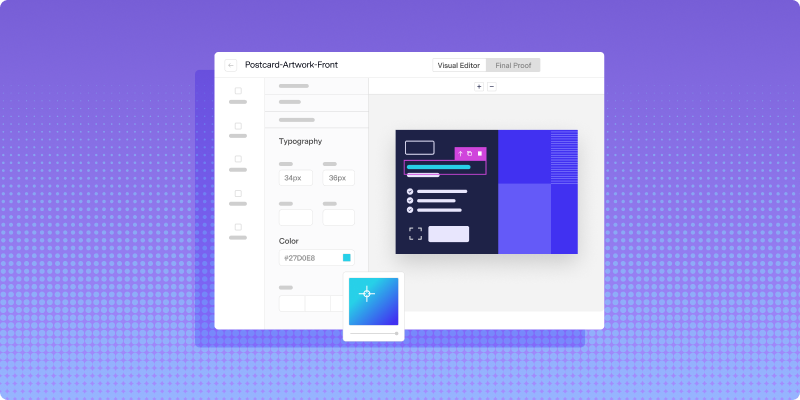
Modern direct mail platforms bring those activities together. Customer data can flow directly from a CRM or marketing automation platform into a reusable template. Each piece can be personalized automatically, checked for address accuracy, sent to production, and monitored as it moves toward delivery.
Instead of sending one static design to everyone on a list, the content and timing can change for each recipient. A purchase, account signup, renewal date, abandoned cart, or period of inactivity can initiate a relevant mailpiece without waiting for the next large batch campaign.
What are the most common types of direct mail?
The format you choose shapes how much information you can include, how the recipient interacts with the piece, and what kind of response the campaign can support. Postcards, letters, self-mailers, and booklets each work best for different messages and campaign goals.
Postcards
Postcards work well for simple, visual messages. Because there is no envelope to open, recipients can see the headline, offer, and call to action immediately.
Brands commonly use postcards for:
- Promotions and product announcements
- Event invitations and appointment reminders
- Abandoned-cart and re-engagement campaigns
- Offers that direct recipients to a QR code or landing page
Letters
Letters provide more room for detailed, personal, or sensitive information. They are often used for account updates, financial communications, healthcare information, insurance notices, onboarding materials, and renewal reminders.
The envelope can add privacy, while the letter format can create a more formal or personal experience than a postcard.
Self-mailers
A self-mailer is folded and mailed without a separate envelope. It provides more room than a postcard while keeping the format relatively simple.
Self-mailers can support multiple offers, step-by-step information, product details, or a detachable coupon or reply section.
Booklets and catalogs
Booklets and catalogs give brands enough space to explain complex products, showcase several offers, or tell a larger story.
They can support seasonal product collections, benefit information, educational content, enrollment materials, and other campaigns where a postcard or letter would feel too limited.
Why do marketers use direct mail?
Direct mail creates a physical interaction that digital messages cannot replicate. A recipient can hold the piece, place it on a counter, share it with someone else, or return to it later.
That staying power can be valuable when a message deserves more attention than it may receive in an inbox or social feed.
Direct mail does not need to replace email, SMS, paid media, or other digital channels. Each serves a different purpose:
- Email supports frequent and immediate communication.
- SMS works well for urgent reminders and short updates.
- Direct mail can reinforce an important message, provide a more memorable experience, or reach people whose digital engagement has declined.
When comparing direct mail and email marketing, the goal is not necessarily to choose one channel over the other. A campaign may use email for quick updates and direct mail for higher-value messages, then coordinate both around the same offer or customer action.
The best approach depends on the audience, campaign goal, timeline, and value of the response.
Traditional versus modern direct mail marketing
Traditional direct mail is usually planned around large batches.
A team builds a mailing list, creates one campaign, and sends the full audience to a printer. That model can work for broad promotions, but it is harder to adjust quickly or connect to individual customer behavior.
Modern direct mail can operate at the recipient level.
Instead of waiting for the next scheduled batch, marketers can define triggers that initiate mail when a specific event occurs. For example:
- A new customer receives a welcome postcard after registering.
- A subscriber receives a reminder before a renewal date.
- A shopper receives a follow-up after abandoning a cart.
- An inactive customer receives a personalized win-back offer.
Teams can also automate direct mail for customer onboarding by connecting signups, purchases, or product activations to relevant welcome letters, postcards, and getting-started materials.
This makes timing part of the personalization. The piece is relevant not only because of what it says, but because it arrives at a meaningful point in the customer journey.
How direct mail personalization works
Personalized direct mail uses customer data to change the content of each mailpiece.
Basic personalization includes the recipient’s name and address. More advanced campaigns can adjust the headline, image, offer, location, expiration date, call to action, or landing-page destination.
A retailer could feature a product category related to a previous purchase. A financial services company could change the message according to account type. A multi-location business could show the nearest store or office.
The campaign does not need a separate design file for every recipient. A reusable template controls the layout, while variable data determines which content appears in each field.
Personalization should still have a clear purpose. Adding more customer information does not automatically make a campaign more useful. The data should make the message more relevant, clarify why the recipient is receiving it, or create a more appropriate next step.
How direct mail fits into the customer lifecycle
Direct mail can support every stage of the customer relationship, not just acquisition.
Common lifecycle uses include:
- Acquisition: Introduce the brand or promote a first-time offer.
- Onboarding: Reinforce setup instructions, product education, or account activation.
- Engagement: Share relevant products, events, benefits, or account milestones.
- Retention: Recognize loyalty, encourage renewals, or provide important reminders.
- Re-engagement: Reach customers whose digital activity or purchasing has declined.
Retention and win-back campaigns can use strategic direct mail to strengthen customer relationships. A physical thank-you note can recognize a loyal customer, while a personalized offer can create a new touchpoint with someone whose digital activity has declined.
The message should reflect the recipient’s current relationship with the brand. A repeat customer should not receive the same introduction as a cold prospect, and a recently active customer may need a different message from someone who has not purchased in months.
How to create a direct mail marketing campaign
A successful direct mail campaign starts with a clear strategy rather than a design file.
1. Define the campaign goal
Decide what you want recipients to do. The goal might be to make a purchase, book an appointment, activate an account, renew a subscription, or return to the brand.
A specific objective helps guide the audience, format, offer, and measurement plan.
2. Choose the audience
Use customer data to identify the people most likely to find the message relevant.
A smaller, well-targeted audience may be more valuable than sending the same offer to every available address. Segments can be based on purchase history, account status, location, engagement, or lifecycle stage.
3. Select the format
Choose a format that supports the message. A postcard may be enough for a simple promotion, while a letter, self-mailer, or booklet may be better for information that requires explanation or privacy.
4. Build the creative around one action
The recipient should quickly understand:
- What the message is
- Why it matters
- What they should do next
A QR code, short URL, personalized URL, phone number, offer code, or reply device can make that next step easy to follow.
Teams also do not need to design every campaign from scratch. Starting with customizable direct mail templates can reduce production time while helping maintain consistent formatting across recurring campaigns.
5. Review and test the campaign
Before launch, review every possible version of the piece. Confirm that variable content renders correctly, links and QR codes work, offers match the intended audiences, and all required terms are included.
Testing a smaller audience first can also help teams identify issues before increasing campaign volume.
Why accurate address data matters
Even strong creative cannot perform if it is sent to an incomplete, outdated, or undeliverable address.
Address errors can lead to delays, returned mail, and wasted production and postage costs. Common problems include:
- Missing apartment or unit numbers
- Misspelled street names
- Outdated customer records
- Incorrectly formatted postal codes
Address validation and verification address different parts of the problem. Validation checks whether an address follows the proper format, while verification confirms that it represents a real location that can receive mail.
Understanding the difference between address validation and address verification helps teams build both processes into the right parts of their campaign and data workflows.
Address quality should be handled before production begins, not after returned mail starts arriving. Verification can also be connected to checkouts, applications, forms, and CRM workflows so errors are caught when the address first enters the system.
How direct mail works with digital marketing
Direct mail becomes more valuable when it supports the rest of the customer experience.
A brand could send a postcard before a seasonal promotion, then reinforce the offer through email and paid media. A customer who does not respond to an email sequence could receive a physical reminder. A welcome letter could direct the recipient to an online tutorial through a QR code.
The messages should feel connected without simply repeating the same content. The creative, offer, timing, and call to action should reflect what the customer has already seen and what should happen next.
In an omnichannel marketing strategy, direct mail adds a physical touchpoint while email, SMS, paid media, websites, and other digital channels support the surrounding experience.
This coordination also makes campaign activity easier to understand. When customer and campaign data move between systems, marketers can evaluate how physical and digital interactions contribute to the same conversion.
How to measure direct mail marketing
Direct mail measurement should begin with the campaign objective.
If the goal is sales, track purchases and revenue. If the goal is customer activation, measure completed activations. Other campaigns may focus on appointment bookings, renewals, lead generation, website visits, or re-engagement.
Trackable elements can connect the physical mailpiece with those actions, including:
- Unique or dynamic QR codes
- Personalized URLs
- Campaign-specific offer codes
- Dedicated phone numbers
- Custom landing pages
- CRM and website conversion data
Delivery information adds context by showing when the piece entered production, moved through the postal network, or approached its expected in-home window.
To measure direct mail campaign performance, teams can connect delivery activity with engagement, conversions, revenue, and other outcomes inside their CRM, analytics platform, or business intelligence tools.
Results should also be reviewed across audiences, creative versions, formats, and campaign sequences. The goal is not only to prove that a campaign generated responses. It is to understand which elements should be repeated, adjusted, or tested in the next send.
How Lob modernizes direct mail marketing
Lob connects digital campaign workflows with physical mail production and delivery.
Teams can use customer data to personalize mail, automate sends, verify addresses, and monitor mailpiece activity without coordinating each step through separate spreadsheets, files, and print vendors.
Reusable HTML templates make it easier to update creative and generate recipient-level variations. Lob’s Print Delivery Network manages production across distributed print partners, allowing campaigns to scale without requiring marketers to coordinate individual facilities.
APIs and integrations connect direct mail with CRMs, marketing automation platforms, customer data systems, and analytics tools. This allows customer behavior to trigger physical mail and lets campaign information flow back into the systems teams already use.
The result is a direct mail channel that can be planned, personalized, automated, and measured alongside digital marketing.
Start using direct mail throughout the customer journey
Direct mail marketing sends physical messages to targeted recipients, but modern campaigns do much more than deliver the same postcard to a large list.
Customer data can determine who receives each piece, what it says, and when it is sent. Automation reduces the manual work behind recurring campaigns, while delivery and response data help teams understand the results.
Direct mail can support acquisition, onboarding, retention, re-engagement, renewals, and other moments throughout the customer lifecycle. The strongest programs use the channel where its physical presence adds value and connect it to the systems managing the rest of the customer experience.
Book a demo to see how Lob can help you create, automate, and measure direct mail marketing campaigns.
Frequently asked questions about direct mail marketing
FAQs

What is direct mail marketing?
Direct mail marketing sends physical promotional materials to a targeted audience through the postal system. Common formats include postcards, letters, self-mailers, booklets, and catalogs.
Is direct mail marketing still effective?
Direct mail can be effective when the audience, message, format, and timing align with the campaign goal. Modern tools also make it possible to personalize, automate, and measure mail instead of relying only on broad batch campaigns.
What are some examples of direct mail marketing?
Examples include abandoned-cart postcards, new-customer welcome letters, renewal reminders, loyalty offers, product catalogs, appointment reminders, event invitations, and win-back campaigns.
How do you run a direct mail marketing campaign?
Begin with a clear objective and targeted audience. Select a suitable format, create the message and offer, verify the address data, add a measurable response method, review the creative, and track delivery and conversion results.
Can direct mail be personalized?
Yes. Customer data can personalize names, messages, images, offers, locations, URLs, QR codes, and other elements. Reusable templates allow those variations to be generated automatically at scale.
Can direct mail work with email and other digital channels?
Yes. Direct mail can be triggered by digital behavior or used before, during, or after email, SMS, paid media, and sales outreach. Connecting the channels creates a more coordinated customer journey.
Answered by:

Sam Melero